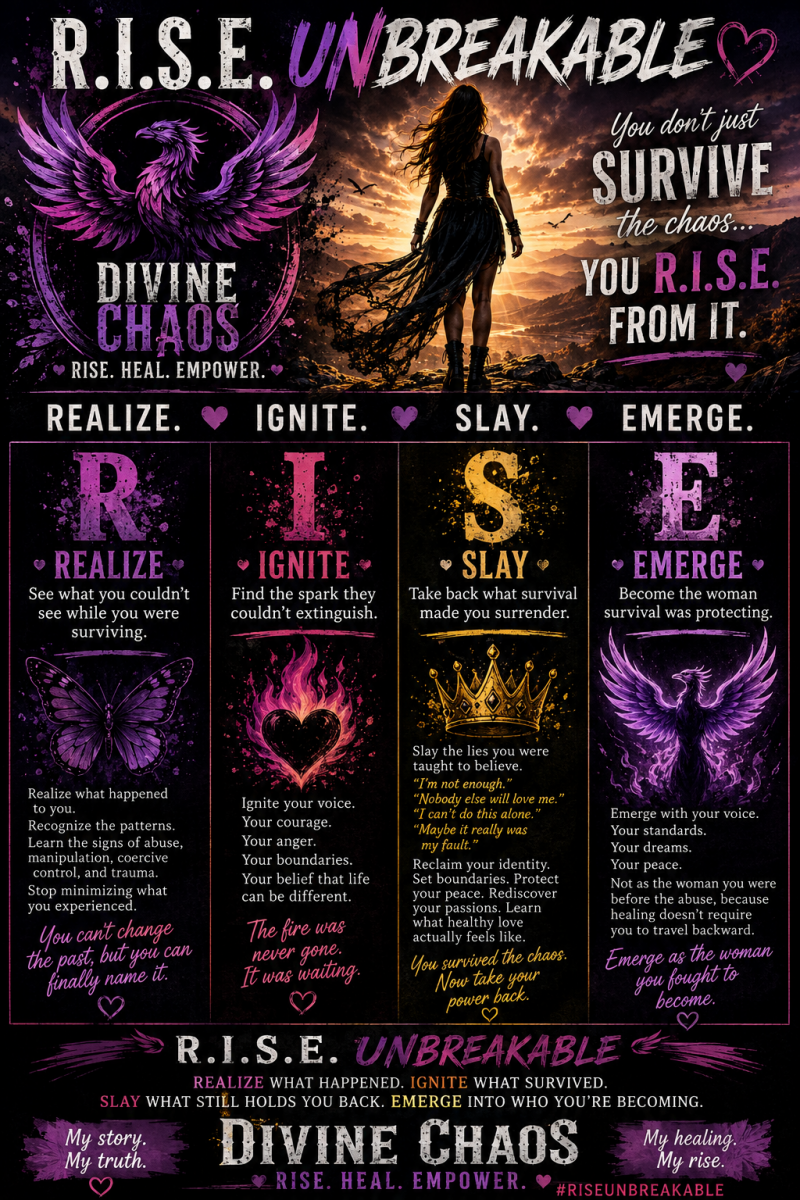
SURVIVE → UNDERSTAND → HEAL → RECLAIM → RISE
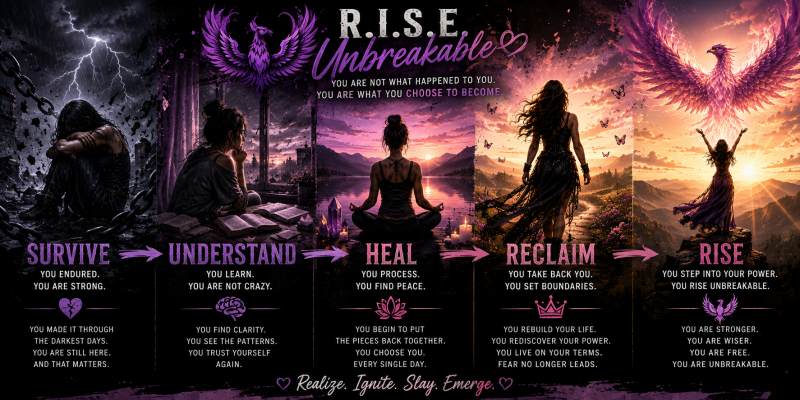
RECOGNIZE THE SIGNS
Sometimes the first step isn't leaving. It's realizing.
Abuse doesn't always begin with a punch.
Sometimes it begins so quietly that you don't recognize it at all.
A comment disguised as a joke.
Jealousy that initially feels like love.
Wanting to know where you are because they "worry about you."
An argument that somehow always becomes your fault.
A boundary pushed just a little farther each time.
A friend you stop seeing because it's easier than dealing with the argument afterward.
Money you slowly lose control over.
A version of yourself that becomes smaller and quieter because keeping the peace feels safer than speaking.
And somewhere along the way, you may begin wondering:
Is this normal?
Am I overreacting?
Maybe I'm the problem.
Does this even count as abuse if they don't hit me?
If you're asking those questions, you deserve information without judgment.
You don't have to label your relationship today.
You don't have to make a decision today.
You can simply start by recognizing the signs.
ABUSE IS ABOUT MORE THAN VIOLENCE
Domestic abuse isn't defined only by physical violence.
At its core, abuse often involves a pattern of behaviors used to gain or maintain power and control over another person.
It can be emotional.
Psychological.
Financial.
Sexual.
Digital.
Physical.
Or a combination of several forms that change over time.
Sometimes the individual behaviors seem small when viewed separately.
But step back and look at the pattern.
Ask yourself:
Who has the power?
Who is constantly adjusting their behavior?
Who is afraid of what happens when the other person gets angry?
That bigger picture matters.
🚩 EMOTIONAL & PSYCHOLOGICAL ABUSE
Not every wound leaves a bruise.
Emotional and psychological abuse can slowly change how you see yourself and your reality.
Signs may include:
- Constant criticism or humiliation
- Calling you names or insulting you
- Mocking your appearance, intelligence, parenting, career, or abilities
- Telling you nobody else would want you
- Deliberately embarrassing you
- Blaming you for their behavior
- Making you responsible for their emotions
- Punishing you with prolonged silence or withdrawal
- Threatening to leave whenever you disagree
- Intentionally destroying your confidence
- Making affection conditional
- Creating unpredictable cycles of kindness and cruelty
- Convincing you that you're "too sensitive," "crazy," or always causing problems
Over time, you may begin questioning yourself before you question them.
That's worth paying attention to.
🚩 COERCIVE CONTROL
Sometimes abuse isn't one dramatic incident.
It's hundreds of small restrictions that slowly take away your freedom.
Coercive control can include:
- Telling you where you can go
- Controlling who you spend time with
- Requiring constant updates about your location
- Setting rules you are expected to follow
- Dictating what you wear
- Controlling when you leave the house
- Monitoring your daily activities
- Interrogating you about ordinary interactions
- Punishing you for making independent decisions
- Making you ask permission for things other adults freely decide
- Controlling transportation
- Using children, pets, finances, housing, or immigration status to control you
Eventually, you may stop asking yourself:
"What do I want?"
And start asking:
"What reaction will this cause?"
That shift is significant.
🚩 GASLIGHTING
Gaslighting is a form of psychological manipulation that can make you question your own perception of reality.
It may sound like:
"That never happened."
"I never said that."
"You're remembering it wrong."
"You're imagining things."
"You're too sensitive."
"You're making a big deal out of nothing."
"Everyone thinks you're crazy."
After enough of this, you may start saving messages, taking screenshots, replaying conversations, or mentally documenting events because you feel like you need evidence of your own reality.
🚩 ISOLATION
Isolation doesn't always begin with:
"You're not allowed to see them."
Sometimes it's subtler.
Your partner starts an argument every time you visit your family.
They criticize your best friend.
They accuse your coworkers of wanting you.
They make gatherings miserable.
They create so much tension before or after you go somewhere that eventually...
You stop going.
Watch for patterns such as:
- Discouraging relationships with friends or family
- Creating conflict around social events
- Making people you love feel unwelcome
- Accusing others of interfering in your relationship
- Becoming excessively jealous of your relationships
- Monitoring calls or messages
- Making you feel guilty for spending time away from them
- Moving you farther away from your support system
- Convincing you that nobody understands you except them
Isolation makes control easier because eventually, there may be nobody left nearby to say:
"This isn't normal."
🚩 ISOLATION
Isolation doesn't always begin with:
"You're not allowed to see them."
Sometimes it's subtler.
Your partner starts an argument every time you visit your family.
They criticize your best friend.
They accuse your coworkers of wanting you.
They make gatherings miserable.
They create so much tension before or after you go somewhere that eventually...
You stop going.
Watch for patterns such as:
- Discouraging relationships with friends or family
- Creating conflict around social events
- Making people you love feel unwelcome
- Accusing others of interfering in your relationship
- Becoming excessively jealous of your relationships
- Monitoring calls or messages
- Making you feel guilty for spending time away from them
- Moving you farther away from your support system
- Convincing you that nobody understands you except them
Isolation makes control easier because eventually, there may be nobody left nearby to say:
"This isn't normal."
🚩 FINANCIAL ABUSE
Money can become a powerful tool of control.
Financial abuse may include:
- Controlling all household money
- Refusing you access to bank accounts
- Taking your paycheck
- Giving you an allowance
- Demanding receipts for purchases
- Preventing you from working
- Sabotaging your employment
- Creating debt in your name
- Hiding financial information
- Taking credit cards or property
- Refusing money for necessities
- Controlling transportation so you cannot work
- Threatening to leave you financially destitute
Financial dependence can make leaving extraordinarily difficult.
That difficulty should never be mistaken for weakness.
🚩 DIGITAL ABUSE & SURVEILLANCE
Technology can become another method of control.
Signs can include:
- Demanding passwords
- Reading private messages
- Checking your call history
- Tracking your location
- Constantly texting or calling to check where you are
- Going through your phone while you sleep
- Controlling who you follow online
- Demanding that you delete people
- Impersonating you online
- Using cameras, accounts, shared devices, or location services to monitor you
- Threatening to share private photos or information
A relationship does not erase your right to privacy and autonomy.
🚩 SEXUAL ABUSE & COERCION
Consent still matters inside a relationship.
Being married, dating, living together, or having previously consented does not mean someone has permanent access to your body.
Sexual abuse or coercion can include:
- Pressuring you into sexual activity
- Continuing after you've said no
- Using guilt, anger, threats, or intimidation to obtain sex
- Ignoring boundaries
- Sabotaging birth control
- Controlling reproductive decisions
- Forcing sexual acts
- Using intimate images to threaten or humiliate you
- Expecting sex as repayment for affection, money, gifts, or basic kindness
Consent must be freely given.
Fear is not consent.
Pressure is not consent.
🚩 PHYSICAL ABUSE
Physical abuse includes more than punching.
It can include:
- Pushing or shoving
- Slapping
- Kicking
- Biting
- Pinning you down
- Restraining you
- Pulling your hair
- Throwing objects at or near you
- Blocking doorways
- Preventing you from leaving
- Driving dangerously to frighten you
- Destroying property to intimidate you
- Hurting pets
- Threatening you with weapons
- Strangulation or choking
Someone doesn't actually have to strike you for physical intimidation to create fear.
Making you believe they could hurt you can itself become a powerful method of control.
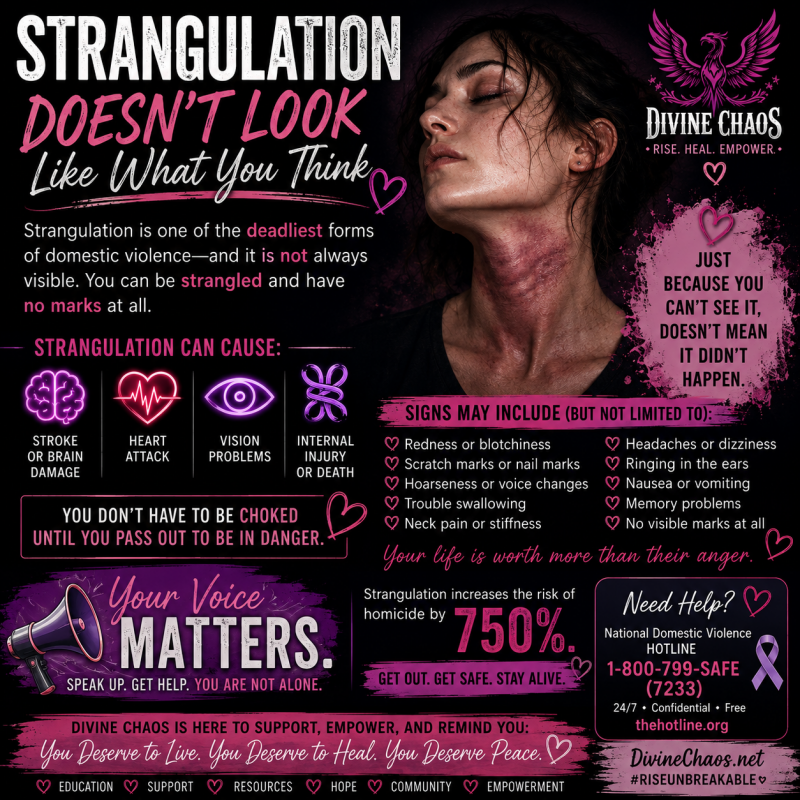
⚠️ STRANGULATION IS ESPECIALLY DANGEROUS
If a partner has put pressure on your neck, strangled or "choked" you, take it seriously.
Strangulation can cause serious internal injuries even when there are few or no visible marks, and complications may not always be immediately obvious.
If this has happened recently, consider seeking medical evaluation, particularly if you experience difficulty breathing or swallowing, voice changes, neck pain or swelling, confusion, weakness, severe headache, vision changes, loss of consciousness, or other concerning symptoms.
🚩 THREATS & INTIMIDATION
Threats don't have to begin with:
"I'm going to kill you."
They may sound like:
"You'll regret it if you leave."
"I'll take the kids."
"Nobody will believe you."
"I'll ruin you."
"If you leave me, I'll hurt myself."
"You'll never make it without me."
Intimidation may also include punching walls, breaking belongings, displaying weapons, reckless driving, looming over you, harming pets, or using facial expressions and gestures you've learned mean danger.
Sometimes eventually they don't have to say anything at all.
You already know what the look means.
THE SIGNS YOU MAY NOTICE IN YOURSELF
Sometimes it's easier to recognize what the relationship has done to you than to identify what your partner is doing.
You may notice that you:
- Walk on eggshells
- Rehearse conversations before having them
- Monitor their mood constantly
- Apologize automatically
- Hide innocent things to avoid an argument
- Feel anxious when you hear their car pull into the driveway
- Change clothes because you're worried about their reaction
- Stop seeing people you love
- Avoid subjects that might upset them
- Feel responsible for keeping them calm
- Constantly question your memory
- Delete harmless messages because you fear how they'll interpret them
- Feel relief when they're away
- Don't recognize yourself anymore
- Spend more time managing their emotions than experiencing your own
And perhaps the biggest question:
Do you feel safe being completely yourself around them?
Not just physically safe.
Emotionally safe.
Safe disagreeing.
Safe saying no.
Safe having boundaries.
Safe making your own decisions.
Safe being imperfect.
Safe having friends.
Safe having privacy.
Safe succeeding.
Safe existing without constantly calculating somebody else's reaction.
🖤 "BUT THEY'RE NOT LIKE THAT ALL THE TIME."
That's one reason abuse can be so confusing.
Someone can hurt you and still have good qualities.
There can be laughter.
Vacations.
Inside jokes.
Beautiful memories.
Apologies.
Gifts.
Affection.
Promises.
Periods when everything feels wonderful again.
Those moments don't automatically erase harmful behavior.
You don't have to decide whether someone is entirely "good" or entirely "bad" to ask whether their behavior toward you is healthy and safe.
"WHY DIDN'T I SEE IT?"
Because when something changes one degree at a time, you may not notice how far you've traveled until you look backward.
The first boundary gets pushed.
Then another.
Then another.
You adapt.
You explain.
You forgive.
You hope.
You become better at predicting moods.
Better at preventing arguments.
Better at surviving.
And eventually something that once would have horrified you becomes another Tuesday.
Recognizing it now doesn't mean you should have recognized it sooner.
It means you're beginning to see.
And seeing changes everything.
YOU DON'T HAVE TO MAKE A DECISION TODAY
Recognizing signs of abuse does not mean someone else gets to decide what you should do next.
Leaving can involve complicated questions about safety, children, housing, finances, transportation, pets, employment, immigration, disability, custody, and much more.
If you believe someone may monitor your devices or internet activity, consider that when looking for information or reaching out for support.
Your next step might simply be:
Learning.
Documenting.
Talking to someone you trust.
Contacting an advocate.
Creating a safety plan.
Or quietly admitting to yourself:
Something about this isn't okay.
That realization matters.
FROM RECOGNIZING TO R.I.S.E.
At Divine Chaos, R.I.S.E. Unbreakable begins here.
R • REALIZE
Recognize what is happening.
Learn the patterns.
Name the behavior.
Trust what you're experiencing.
You don't have to understand everything today.
You only have to begin.
Then, when you're ready:
REALIZE → IGNITE → SLAY → EMERGE
Because recognizing the signs isn't the end of your story.
It may be the beginning of taking it back.
You deserve love without fear.
You deserve boundaries without punishment.
You deserve independence without retaliation.
You deserve disagreements without intimidation.
You deserve to feel safe in your own home.
And you deserve support while figuring out what comes next.
🖤 Welcome to Divine Chaos.
Realize. Ignite. Slay. Emerge.
Together, we #RISEUnbreakable.